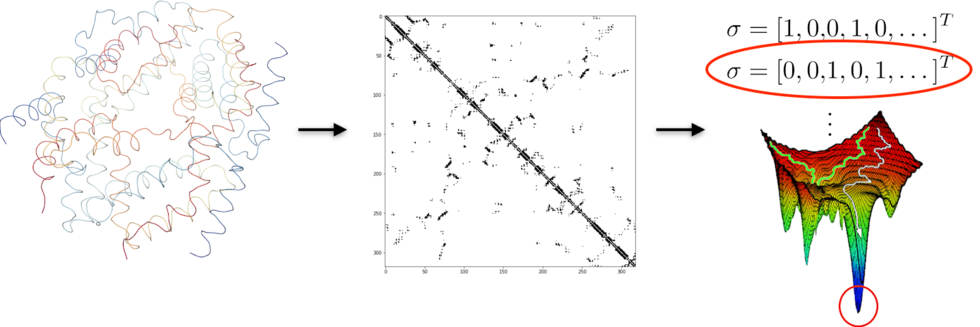
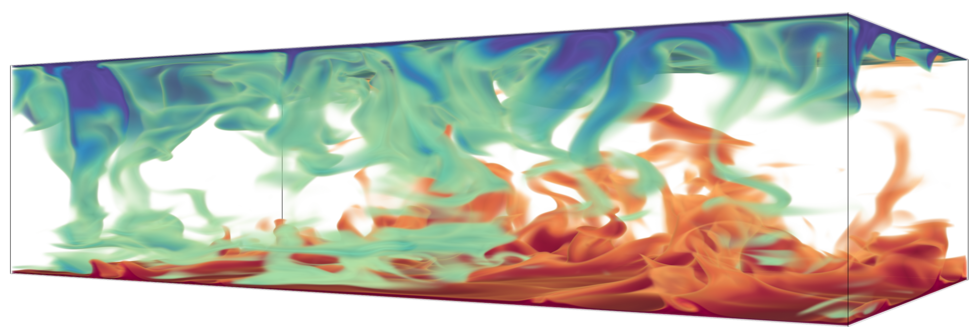
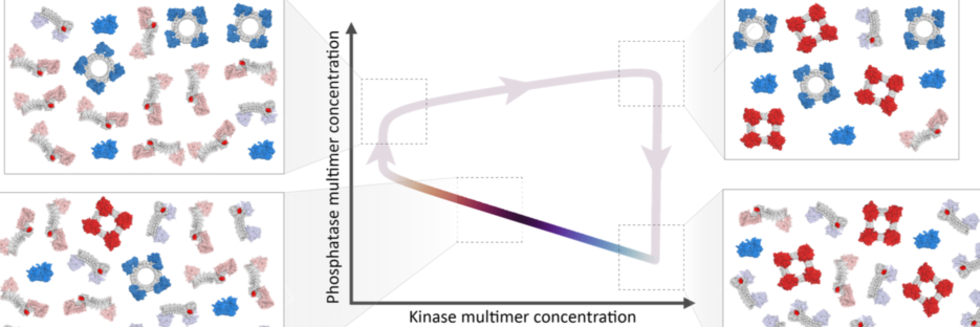
Our research is divided roughly equally into topics in the physical and biological sciences. Examples of current research projects are listed below.
Self Assembly
Self assembly refers to the dream of creating robust methodologies for assembling macroscopic devices without having to do it step by step. The primary difficulty is avoidance of metastable states: for N identical objects there are simple arguments suggesting that the number of metastable states grows exponentially, thus making it completely implausible of developing a (high yield) method for selecting a particular design choice. The question then is whether one can find ways of avoiding this problem-either through kinetic effects or through designing energy functionals that avoid the problem and exhibit a large gap between the ground state and the rest of the metastable states. In a variety of different ways we are working on this problem. Our studies include both theoretical analysis and extension of experimental methodologies as well as more conceptual studies.
Engineering Design
Over the past several years I have become increasingly interested in posing practical engineering design problems in mathematical form, and then finding methods for solving them. Although this is in many ways a well developed field of mathematical activity, there are classes of problems that have not been mathematical formulated. Past work has ranged from a collaboration with design engineers at MIT (Alex Slocum and Jeff Lang) on designing microelectromechanical switches and actuators to the optimal nozzle calculation described below.
The Optimal Nozzle
A standard protocol for producing small droplets is as follows:a pipette, of circular cross section, is pressurized at one end, pushing out a small fluid droplet. If the nozzle is sufficiently small, the liquid surface has constant mean curvature. At a critical pressure p* the equilibrium shape becomes unstable, ultimately leading to the droplet detaching from the nozzle. The size of the droplet produced with this method scales with the radius R of the nozzle; the critical pressure p*~ 1/R. Thus, ejecting small droplets requires higher pressures. The smallest droplet that can be produced depends on the highest p* that can be reliably applied to the nozzle, without materials failure, etc.
But typical nozzles use circular cross-sections. We asked whether one could produce smaller droplets by changing the shape of the nozzle, without changing the critical pressure, and demonstrated that the circle is an extremum of this problem, but a maximum. The best nozzles we found resembled triangles (see accompanying figure), and beat the circular nozzle by about 18%. Efforts are currently underway to test these results experimentally as well as to develop optimal nozzles for other types of forcing.
Fluid Mechanics
Wetting and the No Slip Boundary Conditions The no slip boundary condition in fluid mechanics is an empirical fact whose microscopic origin is still not understood. Recently, several studies reported a severe violation of the no slip condition when the wall is sufficiently hydrophobic; there is a large slip that depends strongly on the shear velocity. We invented a simple model for the experiments \cite{Lauga:2004a}, based on the hypothesis that the solid surface is covered with surface bubbles
(as might occur with surface contamination), which act to change in hydrodynamic pressure. Our predictions are quantitatively consistent with the experiments, suggesting surface bubbles could play an important role.
Humpback Whale Flippers
Humpback whales are often described as very agile whales, capable of
performing rolls and loops under water. Frank Fish hypothesized that there is a connection between their agility and bumpy tubercles on the leading edge of their pectoral flippers. To test this hypothesis, with colleagues from Duke and from the Navy , Fish investigated model flippers in wind tunnels, and found that the bumps lead to an increase in stall angle of up to 40%.
We have been interested in understanding the aerodynamic mechanism for this stall-delay. Recent work with Ernst van Nierop and Silas Alben demonstrates the mechanism for the observed increase in stall angle. Although the bumps have been compared to vortex generators, we propose a different mechanism: we demonstrate that the bumps alter the pressure distribution on the wing such that separation of the boundary is delayed behind bumps; this ultimately leads to a gradual onset of stall and higher stall angle. Our mechanism predicts that as the amplitude of the bumps is increased, the lift curve flattens out leading to potentially desirable control properties. Model airplane builders have started experimenting with this type of wing shape.
Sedimentation
Consider a set of particles sedimenting under gravity, where the Reynolds number of each particle is very small. There are long range hydrodynamic interactions between the particles, and these interactions cause the particles to jiggle around as they fall. The question is: how much do the particles jiggle—ie what are the velocity fluctuations, and hence diffusivities? This question was raised in the 1980’s by Russ Caflisch and Jonathan Luke, and has since had a controversial history. Caflisch and Luke pointed out that under fairly robust assumptions the fluctuations should depend on the size of the box. However this idea contradicted experiments for some time.
We have proposed that system homogeneities (eg size of the box and/or stratifications set up during the development of the sediment) can play a critical role in determining the size of the fluctuations.
The primary question here is what determines the fluctuations in the particle concentration (and hence the velocity fluctuations) in the limit of low volume fraction\cite{caf85,lad96,koc91,nic95b,cha97}. Such fluctuations are important because they dictate the effective diffusivity of a sediment, which heretofore have been considered only empirically.
First, we continued to study fluctuations in a low volume fraction monodisperse sediment, which we believe are limited by the development of particle density gradient in a cell \cite{Mucha:2004}. To this end, we designed a new experiment (with D. Weitz) in which the particle gradient remained constant in time, as opposed to the time dependent gradient of previous experiments. As predicted, the velocity fluctuations settled down to a (stratification dependent) steady state. Numerical simulations quantitatively confirmed the experiments.
We have extended our ideas to a different experimental system, the fluidized bed. Here fluid is pumped upwards through the cell so the density distribution of particles is constant in time. A simple model for the velocity fluctuations was constructed, combining stochasticity in the particle distribution, Stokes drag, and the characteristic relaxation time of the fluidized bed. The model quantitatively captures experiments, including the fact that the size of the correlated regions of particles increases with volume fraction, instead of decreasing as in particle sedimentation.
Splitting a Jet
The fragmentation and control of liquid jets into droplets has been the subject of intense investigation and is at the heart of many technological processes, ranging from ink jet printing to microfabrication. Most efforts for controlling droplet breakup have focused on controlling and modulating the Rayleigh instability. On the other hand, it has long been known that the Rayleigh instability can be suppressed by either viscoelasticity or by a convective flowIn this situation,
a completely different mode for jet breakup might be possible, the splitting of a jet into two separate filaments. In this paper we carry out a theoretical analysis of the conditions for splitting a jet. If jet splitting were controllable, it would provide an entirely novel route for producing small fibers.
The possibility of jet splitting is not mere theoretical fantasy: in uncontrolled situations, jet splitting has been observed when fluid jets interact with electric fields. Old experiments demonstrate that when large axial electric field are applied to a liquid jet, both bending of the centerline of the jet and (more rarely) splitting of the jet into two filaments is observed. More recently there has been much effort aimed at understanding electrospinning, a materials process in which submicron fibers are produced by an electrically forced viscoelastic jet. Although in electrospinning the dominant mechanism for thinning the jet involves bending splitting events have been carefully documented.
We demonstrate that a flowing liquid jet can be controllably split into two separate subfilaments through the application of a sufficiently strong tangential stress to the surface of the jet. In contrast, normal stresses can never split a liquid jet. We apply these results to observations of uncontrolled splitting of jets in electric fields. The experimental realization of controllable jet splitting would provide an entirely novel route for producing small polymeric fibers.
Atmospheric Chemistry
Algorithm Development
Numerical modeling of global atmospheric chemical dynamics presents an enormous challenge, associated with simulating hundreds of chemical species with a broad range of time scales varying from milliseconds to years. We have developed (with Yevgeniy Rastigeyev and Daniel Jacob) an algorithm which provides a significant reduction in computational cost.Since most of the fast reactants and their quickly decomposing reaction products are localized near pollution sources, we use a series of reduced chemical models with increasing distance from the source. The algorithm diagnoses the chemical dynamics on-line, locally andseparately for every species according to its characteristic reaction time.
Unlike conventional time-scale separation methods, the spatial reduction algorithm speeds up not only the chemical solver but also advection-diffusion. Through several examples we demonstrate that the
algorithm can reduce computational cost by at least an order of magnitude for typical atmospheric chemical kinetic mechanisms.
Long ranged Plumes in the Troposophere More recently we have become interested in long ranged plume propagation in the troposphere--both from the standpoint of the underlying physics and from the standpoint of understanding how to accurately represent them in atmospheric chemistry codes (which currently cannot resolve tropospheric plumes.)
Materials Science
Ion Beam Sputtering
This project is a collaboration with material science colleague M. Aziz attempting to understand whether sputtering can used to create predefined structures out of prepatterned surfaces. In the process of exploring this question, we discovered a new regime of ion beam sputtering, occurring for sufficiently steep surface slopes ({\it Science}, {\bf 310}, pgs 234-237(2005)). High slopes propagate over large distances without dissipating the steepest features. Both the propagation velocity and the dynamically selected slope are universal, independent of the details of the initial shape of the surface. The resulting behavior is mathematically equivalent to the propagation of a shock front that self-selects a stable slope; such “undercompressive” shocks have been previously described and observed in the context of a completely different physical process, that of thin film fluid flows. Ion beam sputtering experiments show striking experimental confirmation of the predictions of the theory. An important implication of the propagative behavior at high surface slopes is that a pattern can be fabricated at a large length scale and, through uniform ion irradiation, reduced to a smaller length scale while preserving, or even sharpening, the sharpest features.