

 |
 |
 |
 |
 |
 |
 |
 |



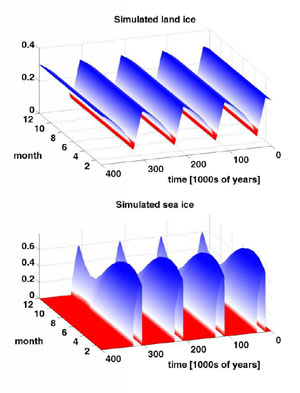 |
The land ice volume (upper panel) and sea ice area (lower) as function of month and time during the glacial cycle from a model of the coupled ocean, atmosphere, land ice and sea ice components of the climate system. |
Permanent El Nino during the Pliocene: Sediment cores taken in the east and west equatorial Pacific show that the present-day surface temperature gradient existed only during the past 2 Myr or so, and was most likely not present during 2-5 Myr ago. This equatorial temperature gradient is eliminated during present-day El Nino events, and this was therefore termed the Pliocene "permanent El Nino". We suggested that this may have been caused by "atmospheric superrotation", which refers to westerly winds at the equator, moving at the same direction as the earth rotation, but at a faster rate. Specifically, with Brian Farrell, we suggested that such superrotation may have been caused by stronger/ reorganized atmospheric convective activity at the equator due to the warmer climate of the Pliocene. The stronger convective noise excites atmospheric Rossby waves which propagate poleward, inducing westerly momentum at the equator, weakening the equatorial easterlies and therefore causing a permanent El Nino [1]. With Nathan Arnold, we then proposed a resonance mechanism between the propagating Rossby waves and the induced westerlies, potentially leading to an abrupt transition to a superrotation state, and perhaps even to a permanent El Nino [2]. Finally, Nathan showed that warmer tropical sea surface temperature, indeed leads to stronger convective "Madden-Julian oscillations" in the tropics, which may excite enhanced Rossby waves [3].
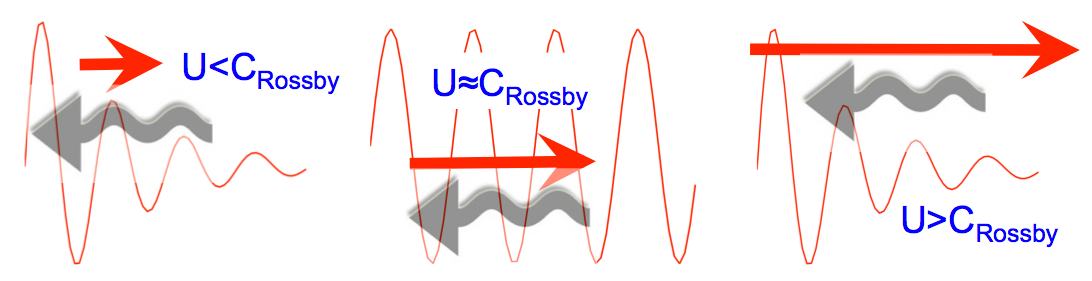
A schematic of the Rossby resonance mechanism leading to a superrotation and possibly a permanent El Nino in warmer climates.
[2].
Equable climate dynamics: The climate of the Cretaceous and Eocene (146-34 Million years ago) was exceptionally warm. Crocodiles and Palm trees, which cannot withstand a night of sub freezing temperatures, could be found in the waters of Greenland and in the middle of present day Canada, were current winter temperatures can drop to -40C. State-of-the-art climate general circulation models cannot reproduce the exceptionally warm continental winter temperature during these periods even with very high atmospheric CO2 concentrations. One wonders whether these models are missing some significant feedback that may also affect their future global warming predictions.
First, we proposed (with Dorian Abbot) that proxy observations of warm high latitude temperatures over the Arctic Ocean and low equator to pole temperature difference during the Eocene and other similar equable climate periods can be explained by tropical-like deep atmospheric convection at high-latitudes. The radiative effects of the high tropospheric clouds associated with the atmospheric convection act to keep the surface warm, and this in turn maintains the convection active. This positive cloud feedback activates as the CO2 concentration is increased, and can explain the absence of ice at high latitudes during the winter as well as the small amplitude of the seasonal cycle. These ideas are developed and investigated using a hierarchy of models: from analytically solvable models, via a simple zonally-averaged two-level atmospheric model (the NCAR Single Column Model with state-of-the-art atmospheric physics, high vertical resolution, a full seasonal cycle, a thermodynamic sea ice model, and a mixed layer ocean) and finally 3D state-of-the-art IPCC coupled ocean-atmosphere-sea ice models used for global warming studies. [See figure below and 1, 2]
Second, we (with Tim Cronin) proposed that continental warmth during warm climate could be due to the suppression of Arctic air formation . The high latitude continental northern US sees occasional extreme cold events during winter due to the penetration of "Arctic air" from Canada. It has been observed that warming over the past couple of decades is especially enhanced over such high-latitude continents during winter time. The two main feedbacks responsible for this enhanced warming are the albedo feedback due to melting snow and sea ice, and a "lapse-rate feedback" which is simply another way of saying that the warming is surface-intensified. We suggested a mechanism that explains this enhanced surface warming as being due to low level clouds developing because of the condensation of warmer and moister air arriving from the ocean. We also showed that as the oceans become even warmer (say 50 Myr ago or perhaps even in a high CO2 future scenario), the process of Arctic air formation that occurs over high latitude continents may be suppressed, leading to a very significant warming there [see figure below and 1].
Please see this
web page prepared by Mark Piana as part of his undergraduate summer project, with more details on equable climate observations and theories.
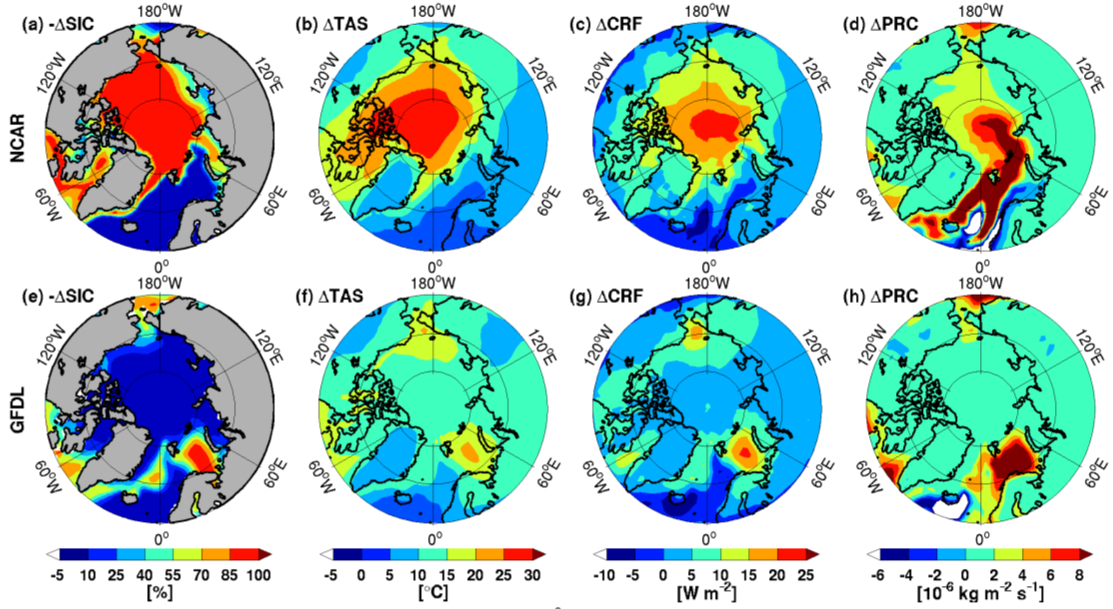
Convective cloud feedback warming the Arctic: Two state-of-the-art coupled climate models demonstrating the convective cloud feedback in a future greenhouse warming scenario. Shown are atmospheric variables over the arctic for the GFDL model (bottom) and NCAR model (top), both at CO2=1120 ppm, and averaged over the polar night winter months (Dec, Jan, Feb). The NCAR model shows (from left to right) a complete arctic sea ice melting, surface temperature increasing up to 25-30C, large cloud radiative forcing, and increased convective precipitation, showing that atmospheric convection is active, leading to the clouds, cloud radiative forcing, surface heating and sea ice melting. The GFDL model shows this feedback active only over a small part of the arctic. Somewhat increased CO2, or longer integration period, are very likely to lead to this feedback also showing up over the entire arctic in the GFDL model. The convective cloud feedback originally proposed to explain the Eocene climate therefore seems also relevant for high CO2 future global warming scenarios.
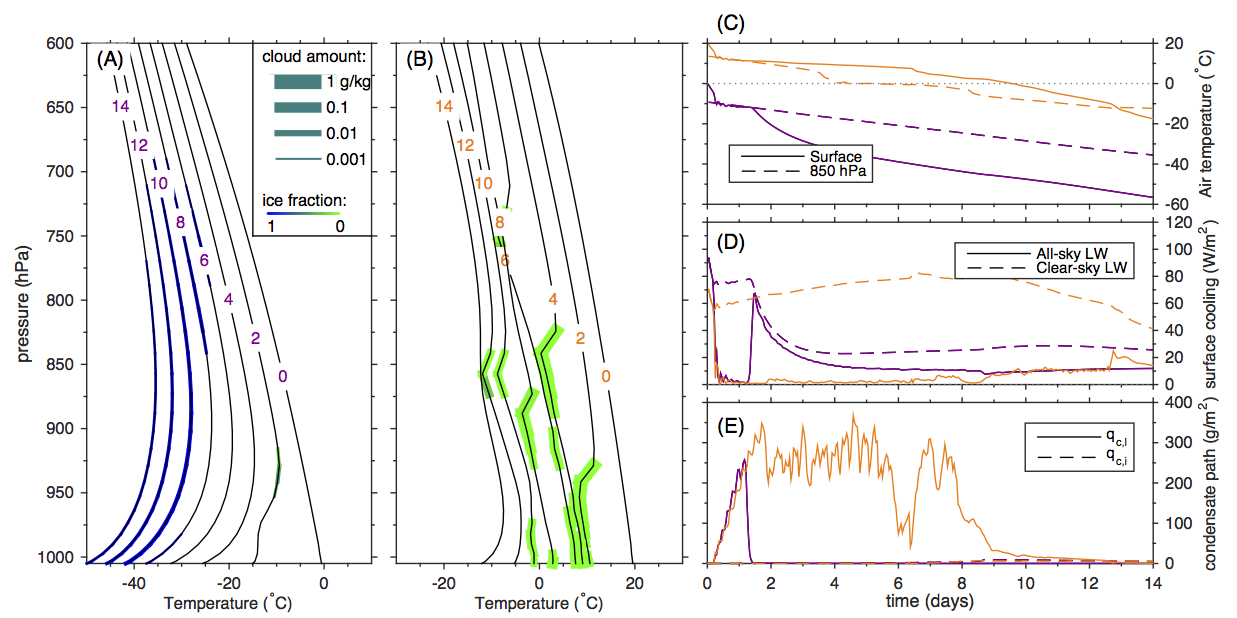
Arctic air suppression in a warm climate: (A) Arctic air formation in a present-day like climate: temperature profiles every two days, starting from marine air, and cooling rapidly as the air is advected over a high latitude continent (Canada...). (B) same in a warmer climate: the air starts out warmer, and Arctic air formation is delayed by the development of low clouds (green and blue lines correspond to ice and water clouds). (C-E) radiative balance for both cases, see here.
Snowball-Earth:
Biologically induced Snowball-Earth initiation: Geologic and paleo-magnetic Evidence suggests that at least two "Snowball earth" events occurred during the Neoproterozoic, 500-800 Myr ago. They were preceded by significant negative isotopic (delta13C) excursions. We attempted to explain both the isotopic excursions and the snowball events as being a result of the evolution of microorganisms. Such organisms (esp. Eukaryotes) saw a period of diversification and evolution during the Neoproterozoic. We examined a scenario in which this evolution led these organisms to sink more effectively to the deep ocean. The deep ocean was anoxic then, and the organic matter was converted to inorganic matter (remineralized) via anaerobic bacteria, in particular via sulfate reducing and iron reducing bacteria. As a result, the ocean alkalinity increased, the pCO2 decreased, and the earth went into a snowball state. This mechanism seems to explain several snowball-related observations, although still involves several uncertainties and open questions [more here].
Ice flow in a snowball ocean: see here.
Ocean circulation in a snowball ocean: The interpretation of geochemical, paleontological and geological Snowball observations can benefit from a knowledge of the ocean circulation at the time. We studied this circulation using analytic methods, coarse models and high resolution models. We found, to our surprise, that even when the ocean is insulated from atmospheric forcing by a km of ice, and the only forcing is a minute geothermal heat flux from the bottom of the ocean, the ocean circulation is still as energetic as at present-day, also see image below.
[1].
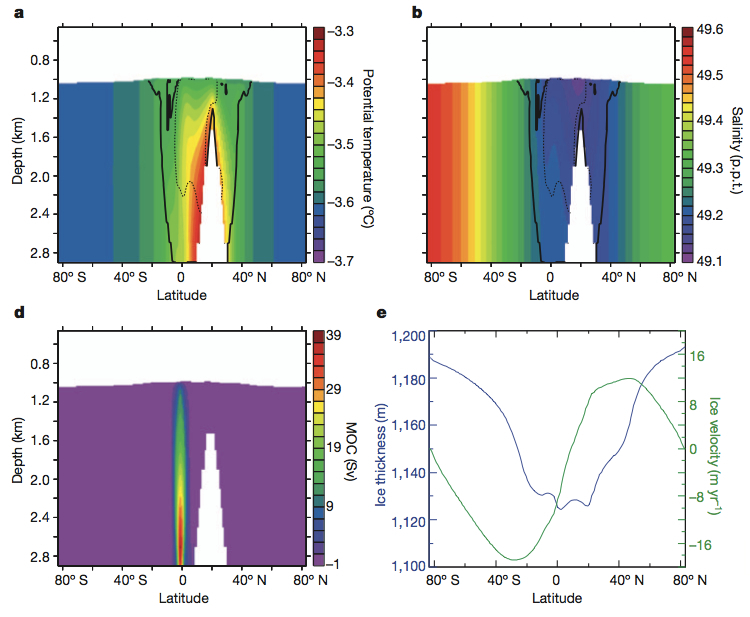
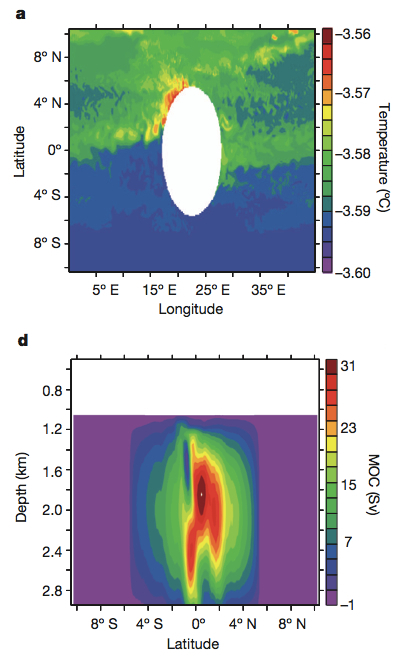
Left two columns: a two-dimensional (latitude-depth) model of snowball circulation under an ice cover showing (a) Temperature, (b) salinity, (d) meridional overturning circulation (at the equator!), and (e) ice thickness and ice velocity. Right column: (a) temperature field under the ice in a 3D high resolution model, showing an energetic turbulent field, and (d) the equatorial meridional overturning circulation in the same model.