Current Projects
Phase Transitions of Atmospheric Particles
- Crystallization of SNAP Particles
- 1×3TDMA
- Atmospheric Nanoparticles
- Modeling Aerosol Phase Transitions and Radiative Effects
Dissolution and Precipitation of Minerals in Aquatic Environments
Chemical Oxidation Reactions and Hydrophobic -to-Hydrophilic Aging of OAs
- Aerodyne AMS analysis
- CCN properties of OAs
Origins of Life: Mineral Surface Photo- Electrochemistry
Harvard Environmental Chamber
AMAZE-08
Closed Projects
-
Crystallization of Sulfate and Nitrate Coatings on Tropospheric Mineral Particles -
Tropospheric Mineral
Particles as Ice Nuclei
- Building Structures at the Nanoscale
|
Modeling Aerosol Phase Transitions and Radiative Effects
Sulfate aerosols are one of the most important types of anthropogenic aerosols in the atmosphere.
They scatter incoming solar radiation, which impacts a net cooling effect on the Earth surface. Sulfate aerosols
can also affect various chemical pathways such as N2O5 hydrolysis. To accurately quantify
the extent which sulfate aerosols affect both atmospheric chemistry and the radiative budget, knowledge of their
phase is needed. For example, if aqueous these particles will grow in size at high relative humidity, thus scattering
solar radiation more effectively than if they were solid.
Polynomial rules have been developed by the Martin group to characterize crystallization relative humidity (CRH)
for ammonium-nitrate-sulfate as a function of X and Y, where X is the ammonium fraction of the particles
chemical composition and Y is the sulfate fraction. Our work is then to implement these results into GEOS-CHEM (a 3-D
chemical transport model) to characterize the state of these aerosols. Currently, we are only exploring the ammonium sulfate
system but plan to address the ammonium-nitrate-sulfate system in the future.
Predicted boundary layer partitioning of sulfate among ammonium sulfate (AS), letovicite (LET), and ammonium bisulfate (AHS),
of nitrate as ammonium nitrate (AN), and of water as aqueous solution. |
Polynomial rules:
where CRH is the crystallization relative humidity, X is the nitrate fraction of the particle's chemical composition, and Y is
the sulfate fraction. We are using these results in an ongoing project to further assess the effects of particle phase
on radiative forcing and atmospheric chemistry (e.g., aqueous particles are typically 104 times as reactive
as crystalline particles towards heterogeneous chemical hydrolysis reactions).
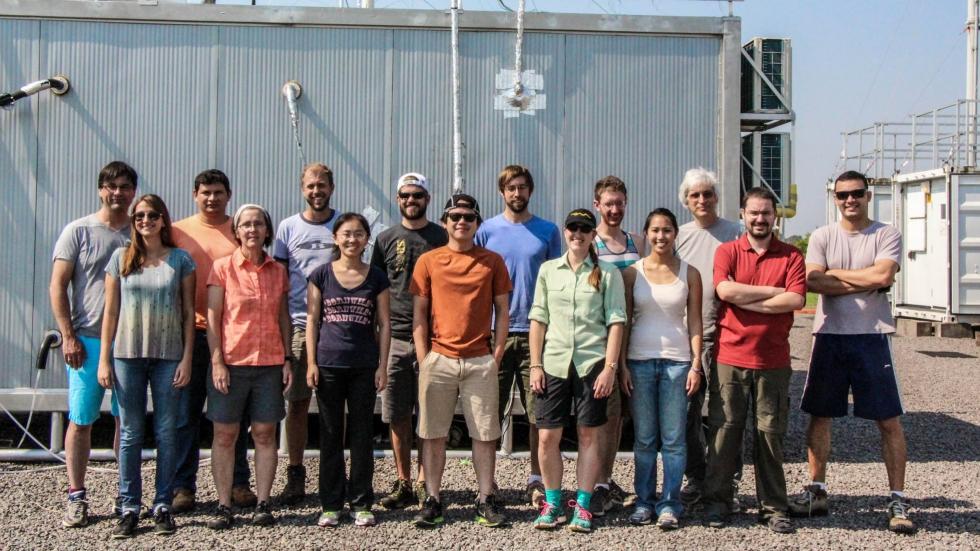
People Involved
Publications
J. Wang, A.A. Hoffmann, R. Park, D.J. Jacob, and S.T. Martin, "Global distribution of solid and aqueous sulfate aerosols: effect of the hysteresis of particle phase transitions," Journal of Geophysical Research, 2008, 113, D11207.
PDF File.
J. Wang, D.J. Jacob, and S.T. Martin, "Sensitivity of sulfate direct climate forcing to the hysteresis of particle phase transitions," Journal of Geophysical Research, 2008, 113, D11206.
PDF File.
J. Wang and S.T. Martin, "Satellite characterization of urban aerosols: importance of including hygroscopicity and mixing state in the retrieval algorithms," Journal of Geophysical Research, 2007, 112, D17203.
PDF File.
Martin, S.T., H.M. Hung, R.J. Park, D.J. Jacob, R.J.D. Spurr, K.V. Chance, and M. Chin, "Effects of the Physical State of Tropospheric Ammonium-Sulfate Nitrate Particles on Global Aerosol Direct Radiative Forcing," Atmospheric Chemistry and Physics, 2004, 4, 183-214.
PDF File. Table 2 Erratum.
|