Current Projects
Phase Transitions of Atmospheric Particles
- Crystallization of SNAP Particles
- 1×3TDMA
- Atmospheric Nanoparticles
- Modeling Aerosol Phase Transitions and Radiative Effects
Dissolution and Precipitation of Minerals in Aquatic Environments
Chemical Oxidation Reactions and Hydrophobic -to-Hydrophilic Aging of OAs
- Aerodyne AMS analysis
- CCN properties of OAs
Origins of Life: Mineral Surface Photo- Electrochemistry
Harvard Environmental Chamber
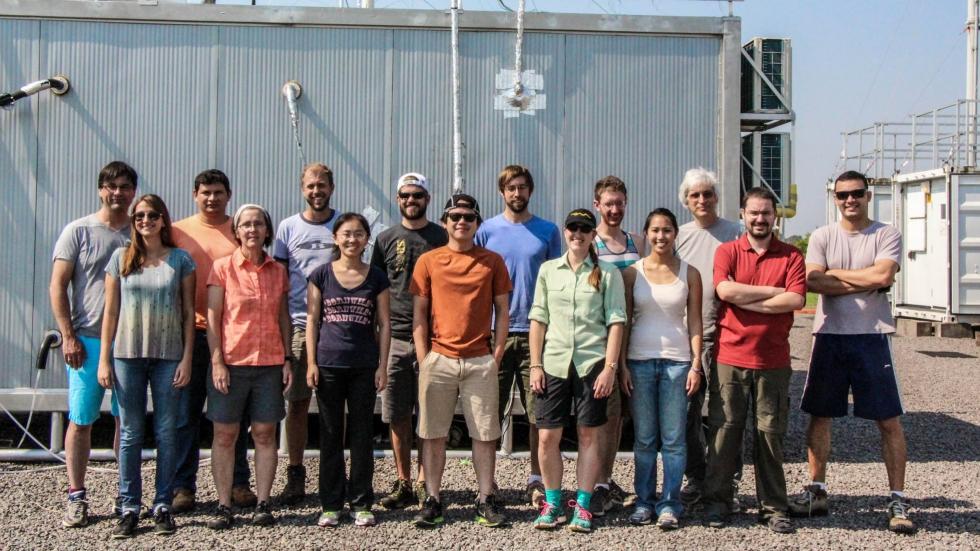
AMAZE-08
Closed Projects
-
Crystallization of Sulfate and Nitrate Coatings on Tropospheric Mineral Particles -
Tropospheric Mineral Particles as Ice Nuclei
- Building Structures at the Nanoscale
|
Aerodyne AMS Analysis of Hydrophobic to Hydrophilic Aging of Atmospheric Organic Aerosol Particles
Oxidative processing (i.e., "aging") of organic aerosol particles in the troposphere affects their cloud condensation nuclei (CCN) activity, yet the chemical mechanisms remain poorly understood. In this study, oleic acid aerosol particles were reacted with ozone while particle chemical composition and CCN activity were simultaneously monitored. The CCN activated fraction at 0.66 ± 0.06% supersaturation was zero for 200-nm mobility diameter particles exposed to 565 to 8320 ppmv O3 for less than 30 s. For greater exposure times, however, the particles became CCN active. The corresponding chemical change shown in the particle mass spectra was the oxidation of aldehyde groups to form carboxylic acid groups. Specifically, 9-oxononanoic acid was oxidized to azelaic acid, although the azelaic acid remained a minor component, comprising 3-5% of the mass in the CCN-inactive particles compared to 4-6% in the CCN-active particles. Similarly, the aldehyde groups of alpha-acyloxyalkyl-hydroperoxide (AAHP) products were also oxidized to carboxylic acid groups. On a mass basis, this conversion was at least as important as the increased azelaic acid yield. Analysis of our results with Köhler theory suggests that an increase in the water-soluble material brought about by the aldehyde-to-carboxylic acid conversion is an insufficient explanation for the increased CCN activity. An increased concentration of surface-active species, which decreases the surface tension of the aqueous droplet during activation, is an interpretation consistent with the chemical composition observations and Köhler theory. These results suggest that small changes in particle chemical composition caused by oxidation could increase the CCN activity of tropospheric aerosol particles during their atmospheric residence time.
 | | Figure 1. Representation of the chemical changes that occur upon activation of ozonized oleic acid aerosol particles. Aldehyde groups are oxidized to carboxylic acid groups, transforming AAHP-1, AAHP-2, and OA into AAHP-1*, AAHP-2*, and AA, respectively. The chemical mechanism is shown in Figure 2. |
 | | Figure 2. Chemical mechanism showing the oxidation of aldehydes to carboxylic acids by ozone. The conversion of aldehyde to acid functionalities is associated with the increase in CCN activity observed for oleic acid aerosol particles at high ozone exposures. |
People Involved
Publications
J.S. Shilling, S.M. King, M. Mochida, D. Worsnop, and S.T. Martin, "Mass Spectral Evidence that Small Changes in Composition Caused by Oxidative Aging Processes Alter Aerosol CCN Properties," Journal of Physical Chemistry A, 2007, 111, 3358-3368.
PDF File. Supporting Information.
|