Current Projects
Phase Transitions of Atmospheric Particles
- Crystallization of SNAP Particles
- 1×3TDMA
- Atmospheric Nanoparticles
- Modeling Aerosol Phase Transitions and Radiative Effects
Dissolution and Precipitation of Minerals in Aquatic Environments
Chemical Oxidation Reactions and Hydrophobic -to-Hydrophilic Aging of OAs
- Aerodyne AMS analysis
- CCN properties of OAs
Origins of Life: Mineral Surface Photo- Electrochemistry
Harvard Environmental Chamber
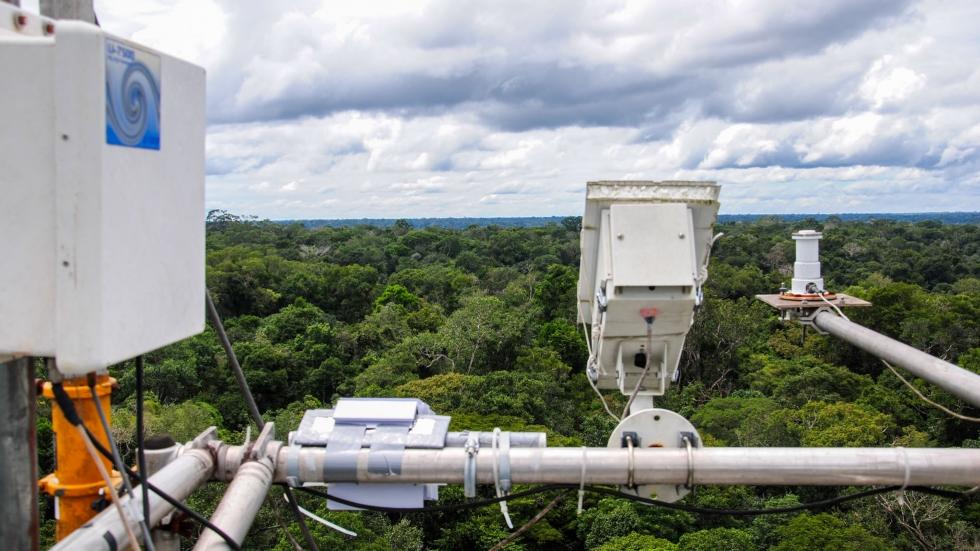
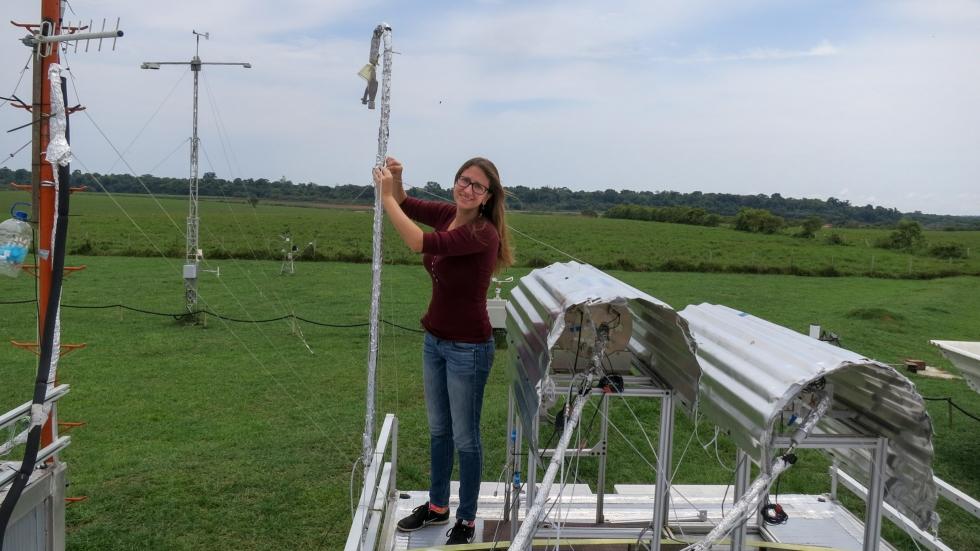
AMAZE-08
Closed Projects
-
Crystallization of Sulfate and Nitrate Coatings on Tropospheric Mineral Particles -
Tropospheric Mineral Particles as Ice Nuclei
- Building Structures at the Nanoscale
|
Mineral Surface Photoelectrochemistry to Reduce Inorganic Carbon
and Form the Prebiotic Soup
How did life begin?
|

|
We are investigating mineral surface photoelectrochemistry as a pathway
to reduce inorganic carbon and form a prebiotic soup of organic precursors
to life. Basic project questions are: What CxHyOzSaNb
molecular products result from CO and CO2 photoreduction
over semiconductor supports? What important synthesis reactions relevant
to prebiotic chemistry, which are otherwise "no go" via thermal
pathways, become possible through semiconductor photocatalysis? Relevant
semiconductors for early Earth include ZnS, TiO2, ZnO, and
MnS. The list expands for chemistry occurring on interstellar dust, which may have seeded organic molecules into the prebiotic soup.
From the five known mechanisms by which autotrophic organisms fix carbon, a reductive tricarboxylic acid (rTCA) cycle has been proposed as the most plausible metabolic pathway of CO2 fixation at the time life originated. A nonenzymatic rTCA cycle might have functioned as an autocatalytic network of chemical reactions able to provide and self-sustain the biosynthetic pathways essential for life to originate. For these reasons, we are currently studying the kinetics of some reactions of the reverse Krebs cycle driven by mineral photochemistry, and the thermal competition pathways. We intend to understand if this chemical cycle could have been related to the origin of prebiotic metabolism.
|

|
|

|
| Photochemical setup. 500 mL reaction vessel with water jacket around it. In the center a quartz immersion well holds a turned on UV lamp (wavelength 200 to 400 nm). Sphalerite (ZnS, white) suspension is stirred continuosly. |
We are grateful for support received from the Harvard Origins of Life Initiative and the NASA Exobiology Program.
Link
The Harvard origins of life initiative
People Involved
Publications
M. Guzman and S.T. Martin, "Prebiotic metabolism: Production by mineral photoelectrochemistry of a-ketocarboxylic acids in the reductive tricarboxylic acid cycle," submitted March 2009.
M.I. Guzman and S.T. Martin, "Oxaloacetate-to-malate conversion by mineral photoelectrochemistry and implications for the viability of the reductive tricarboxylic acid cycle in prebiotic chemistry," International Journal of Astrobiology, 2008, 7, 271-278.
PDF file.
A. Tarnowski, X. Zhang, C. McNamara, S. T. Martin, and R. Mitchell, "Biodeterioration and Performance of Anti-graffiti Coatings on Sandstone and Marble," Journal of the Canadian Association for Conservation, 2007, 32, 3-16.
PDF File.
X.V. Zhang, S.P. Ellery, C.M. Friend, H.D. Holland, F.M. Michel, M.A.A. Schoonen, and S.T. Martin, "Photodriven Reduction and Oxidation Reactions on Colloidal Semiconductor Particles: Implications for Prebiotic Synthesis," Journal of Photochemistry and Photobiology A: Chemistry, 2006, 185, 301-311.
PDF File.
X.V. Zhang and S.T. Martin, "Driving Krebs Cycle in Reverse through Mineral Photochemistry," Journal of the American Chemical Society, 2006, 128, 16032.
PDF File. Press Received.
Michel, F.M., Schoonen, M.A.A., Zhang, X.V., Martin, S.T., and Parise, J.B., "Hydrothermal Synthesis of Pure a-Phase Manganese (II) Sulfide Without the Use of Organic Reagents," Chemistry of Materials, 2006, 18, 1726-1736.
PDF File.
Perry, T.D., Klepac-Ceraj, V., Zhang, X.V., McNamara, C.J., Poltz, M.F., Martin, S.T., Berke, N., and Mitchell, R., "Binding of harvested bacterial exopolymers to the surface of calcite," Environmental Science and Technology, 2005, 39, 8770-8775.
PDF File.
Zhang, X.V., S.T. Martin, C.M. Friend, M.A.A. Schoonen, and H.D. Holland, "Mineral-Assisted Pathways in Prebiotic Synthesis: Photoelectrochemical Reduction of Carbon(+IV) by Manganese Sulfide," Journal of the American Chemical Society, 2004, 126, 11247-11253.
PDF File.
|