 |
 |
 |
 |
 |
 |
 |
 |



 |
|
|

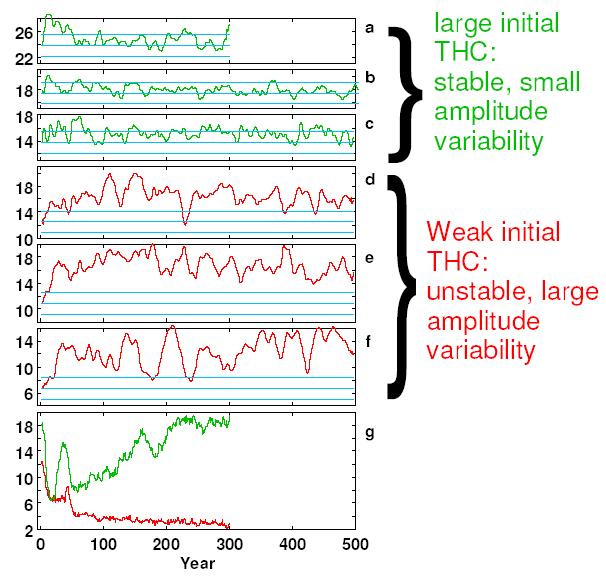
Stability of the MOC and its possible proximity to an instability threshold: The MOC has been remarkably stable and its variability quite small over the Holocene (past 10,000 years). The much stronger climate instability and high frequency variability seen in high resolution ice and deep sea cores throughout the preceding 150,000 years has been linked to similarly stronger past MOC variability (most likely amplified by sea ice feedbacks, see our paleo climate activities). We proposed that present day climate may be close to a "stability threshold" such that the MOC may become unstable if it reduces by about 25%. Once unstable, the MOC may rapidly increase, collapse, or display strong oscillations. This idea was examined in both simple conceptual models, ocean general circulation models, and "realistic" coupled ocean-atmosphere general circulation models. [e.g., 1, 2]
The existence of a weak unstable MOC regime may account for the larger MOC and climate variability prior to the Holocene. The implicationsto greenhouse scenarios that predict a weakening of the MOC are clearly an important yet open issue. (With collaborators from GFDL/ Princeton University).
 |
|
|
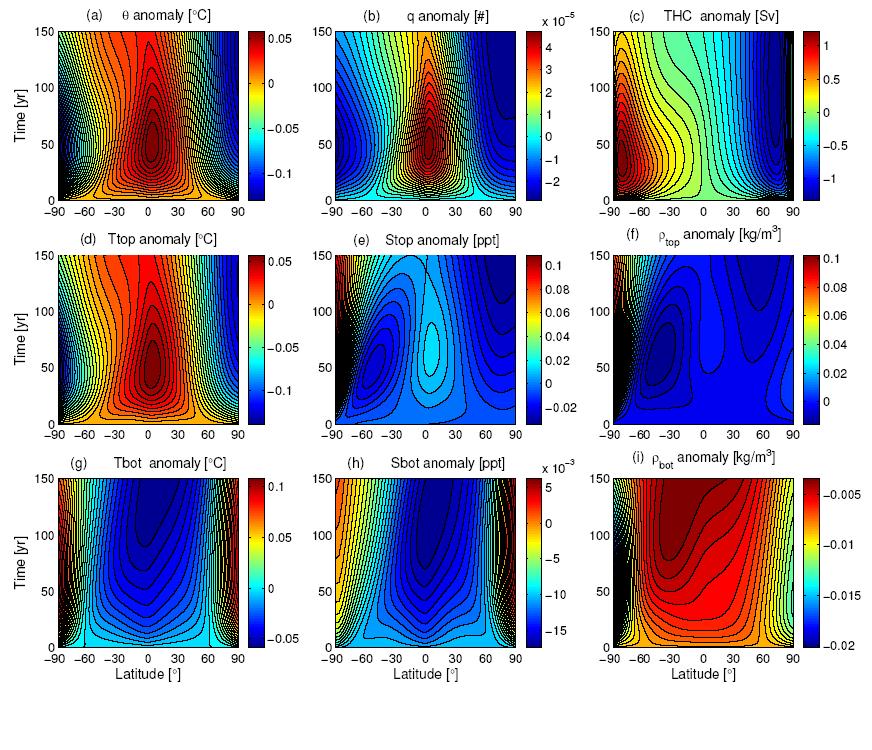
MOC variability: Although generally stable over the past 10,000 years, the MOC still varies on time scales of decades to centuries. This variability may have been a factor in the "little ice age" (1550–1850), or "medieval warm period" (from the 10th century to about the 14th century), for example. We have examined possible mechanisms for such variability, from a linear oscillatory MOC mode excited by stochastic atmospheric forcing, to a strong "transient amplification" of MOC anomalies by what's known as "non normal" dynamics [1, 2, 3]